
White Paper on Quranic Finance Easy Marriage Initiative.
What is Quranic Finance Easy Marriage Initiative
The Quranic Finance Easy Marriage Initiative is a community project designed to make marriage simple again. It aims to remove the barriers that young Muslims face today—especially the growing problem of excessive mahr. It seeks to revive the original spirit of Islamic marriage: simplicity, mercy, and ease.
Why This Initiative Came Into Existence - The Problem
Around the world, societies are facing moral and social crises at levels we have never seen before. Across almost every country, the rise of these destructive issues is alarming:
Rape
Female abuse
Pornography addiction
Vulgarity
Fornication
These problems are rising everywhere. Families are breaking. Communities are hurting. The moral foundation of society is slowly eroding. Every nation is struggling with these issues, trying to find a solution.
But the solution already exists. Islam gave it long ago — marriage.
It is a timeless shield. A sunnah practiced by all the prophets.
Allah says:
“And among His signs is that He created for you spouses… and placed between you affection and mercy.” (Ar-Rum 21)
And He warns:
“Do not go near zina. Indeed, it is ever an immorality and is evil as a way.” (Al-Isra 32)
Marriage brings peace. It protects the heart. It protects society.
Think of the dinosaurs — wiped from the earth, gone forever. Without marriage, humanity would face the same fate.
Marriage is the only legitimate path that preserves lineage and keeps human life continuing. Without it, societies would collapse just as extinct species vanished.
Yet today, despite all its blessings, marriage has become a burden for many Muslim communities. Young Muslims fear it — not because they reject marriage, but because they simply cannot afford it.
The biggest barrier they face is excessive mahr.
Mahr : From token-of-love to a tool-of-competition
In a Muslim marriage, the groom must give a mandatory gift to the bride. This gift is called Mahr — and it is not dowry.
Mahr can be money, gold, property, or even something simple and meaningful, like teaching a dua. Many marriages of the Sahabah were based on such meaningful gifts.
Mahr was meant to be a token of love.
But over time, that token of love turned into a tool of competition.
Since the groom is obliged to pay the mahr at the time of marriage, the bride’s guardians often ask for a high amount. Sometimes the demand comes from greed — but not always. Many times it comes from social pressure, comparison, and the belief that a high mahr brings high honor.
In many localities, if one family sets the mahr at USD 1,000 for their beloved daughter, the next family raises it to USD 2,000. Not for need, but to prove they are “higher” in status.
This is how the comparison and show-off mindset pushes the mahr higher and higher.
The result is painful. Excessive mahr has built a wall between thousands of young Muslims and their right to get married.
Eventually, Mahr has shifted from a symbol of love to a symbol of social status.
That is the real problem: a gift of love has become a tool of competition.
How to solve the problem : Reversing the Competition
At Quranic Finance, we asked ourselves a simple question.
If people love show-off and status competition so much, why not redirect that energy toward something good?
So we created an initiative that flips the entire game.
The concept is very simple.
Every year, we collect information about marriages that took place in a locality—let’s say a village—over the previous two years.
Then we prepare a leaderboard – ranking all marriages based on the Mahr amount, from the lowest to the highest.
The lowest Mahr gets the top position. The highest goes to the bottom.
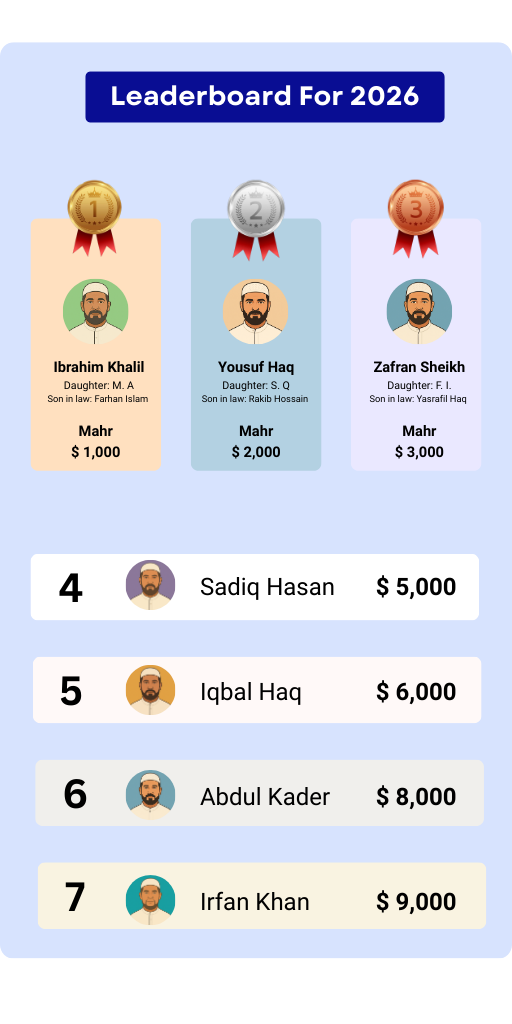
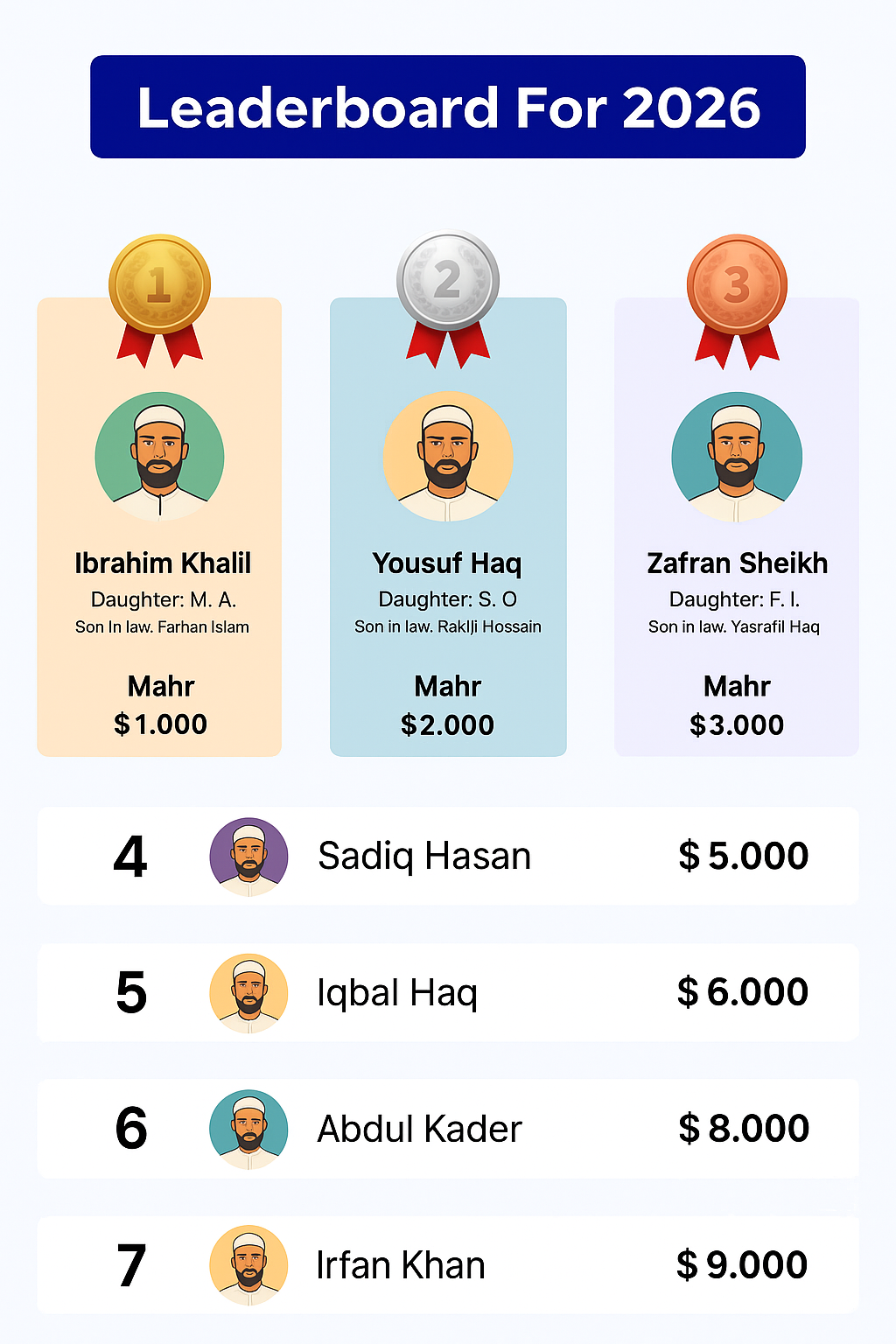
After creating the leaderboard, we honor the top marriage—the one with the lowest Mahr.
The honor goes to the father or the legal guardian of the groom for accepting the lowest Mahr.
And this honor must be grand, seems like an award-giving ceremony. In public. In front of the whole community.
It’s a moment that makes the groom’s father feel truly prestigious.
This recognition carries powerful emotion. It makes the guardian respected. It gives him real honor in society.
It creates the feeling of being unique and different from others—something people usually try to achieve through show-off and high Mahr.
With this, we hope to create a shift.
Families who once demanded high Mahr for status will now lower it to earn respect, social honor, and spiritual reward.
Slowly, the mindset will begin to change.
When this continues for years, a cultural transformation starts.
Instead of competing for the highest Mahr, families begin to compete for the lowest.
How Quranic Finance Implements This Program
At QuranicFinance.com, we are already implementing this initiative in Bangladesh.
Each year, we collect marriage information from the previous two years through a structured registration form.
Based on the submitted data, we publish a real-time leaderboard on our website, ranking marriages from the lowest to the highest mahr.
During May–June, a panel of qualified jurists reviews the top three lowest-mahr marriages. Their evaluation follows a defined policy and procedure, which is outlined in the next section.
At the end of June, we formally announce the final winner.
Later the winning marriage is honored with a Free Umrah Package at a public event. The package is awarded to the groom’s father or legal guardian.
How Winner is Selected
Our winner selection process is clear, fair, and fully aligned with Islamic principles.
We choose the final winner based on two main factors:
Amount of mahr
Education level of both bride and groom*
*Education Requirement
Along with the mahr amount, we also consider the level of education of both groom and bride. This encourages guardians to provide basic education before marriage.
The minimum education level for both bride and groom is: HSC / Alim / A-level or an equivalent qualification. Without this, a marriage does not qualify for evaluation.
We also address a common issue: many families delay marriage just to complete higher education. We do not encourage delaying marriage for this reason.
So, we use an education scoring system that rewards continuing education after marriage.
If the bride or groom studies further after marriage, they receive more points and higher chances of winning.
Detailed procedure for winner selection is outlined below:
Step 1: Selecting the Top 3 Marriages (Based on lowest Mahr)
First, we create a leaderboard ranking all submitted marriages from lowest to highest mahr.
From this leaderboard, we pick the first three marriages— but with one condition: the groom & bride must have had a minimum education level of HSC, Alim, A-level, or an equivalent qualification at the time of marriage.
If this condition does not meet, we skip that marriage and move to the next one.
Once we find three marriages that meet the rule, these become the Top 3 finalists.
Step 2: Selecting the Final Winner (100-Point System)
In this stage, the Top 3 marriages are evaluated using a 100-point scoring system. These 100 points are divided across the following metrics:
- Mahr Amount — Max 60 Points.
- Bride’s Current Level of Education — Max 20 Points
- Groom’s Current Level of Education — Max 20 Points
Summary of Scoring
| Metric | Description | Max Points |
| Mahr Amount | Lower mahr = higher score | 60 |
| Bride’s Education | Based on current level of education | 20 |
| Groom’s Education | Based on current level of education | 20 |
| Total | 100 |
Mahr amount scoring in detail
The mahr amount has the highest weight in our scoring system, with a maximum of 60 points. Mahr is the core element of this initiative, so lower mahr earns higher scores. Among the Top 3 finalists, the marriage with the lowest mahr gets 60 points. The second lowest receives 50 points, and the third lowest receives 40 points.
| Position (Based on Mahr Amount) | Description | Points |
|---|---|---|
| 1st (Lowest Mahr) | Marriage with the lowest mahr among the finalists | 60 |
| 2nd (Second Lowest Mahr) | Marriage with the second lowest mahr | 50 |
| 3rd (Third Lowest Mahr) | Marriage with the third lowest mahr | 40 |
Education level scoring in detail
At this stage, we evaluate the bride and groom’s current education level, not the education they had at the time of marriage. Education at the time of marriage is only used in Step 1 to select the Top 3 finalists. In this step, we look at their present level of education.
This scoring method encourages higher studies without encouraging anyone to delay marriage. A couple who married after completing only HSC can still earn high scores by continuing their education after marriage.
The following scoring applies equally to both the bride and the groom:
| Education Level | Points for groom | Points for bride |
| Minimum requirement (HSC/Alim/A-level) | 8 | 8 |
| Graduation ongoing | 10 | 10 |
| Graduation completed | 12 | 12 |
| Post-graduation ongoing | 14 | 14 |
| Post-graduation completed | 16 | 16 |
| M.Phil ongoing | 18 | 18 |
| M.Phil completed | 19 | 19 |
| PhD (ongoing or completed) | 20 | 20 |
Total Score Calculation and The Winner Selection
Each finalist receives a total score out of 100 points: Mahr Score (60) + Bride’s Education Score (20) + Groom’s Education Score (20)
The marriage with the highest score becomes the Winner of the Year.
If two scores are equal, the marriage with the lower mahr wins.
An Example
To understand the scoring more clearly, consider three finalist marriages.
Marriage 1 has a mahr of 4,000 USD. The groom has completed graduation (12 points), and the bride is doing her graduation (10 points).
Marriage 2 has a lower mahr of 3,500 USD. The groom has completed a PhD (20 points), and the bride has completed graduation (12 points).
Marriage 3 has the lowest mahr of 3,000 USD. The groom is doing post-graduation (14 points), and the bride has completed post-graduation (16 points).
Based on the rules, the lowest mahr receives 60 points, the second lowest 50 points, and the highest mahr 40 points. After adding the education scores, we calculate the total points for each marriage to determine the winner.
| Category | Marriage 1 | Marriage 2 | Marriage 3 |
|---|---|---|---|
| Mahr Amount | 4,000 USD Score: 40 | 3,500 USD Score: 50 | 3,000 USD Score: 60 |
| Bride Education | Graduation ongoing Score: 10 | Graduation completed Score: 12 | Post-graduation completed Score: 16 |
| Groom Education | Graduation completed Score: 12 | PhD completed Score: 20 | Post-graduation ongoing Score: 14 |
| Total Score | 62 | 82 | 90 |
Marriage 3 wins with a total score of 90 points.
If their scores were equal, Marriage 3 would still win because it has the lower mahr.
Verification Requirements
The following must be verified before scoring:
- Mahr amount must be realistic, not artificially reduced.
- Mahr must be clearly written in the Nikah Nama/Marriage Certificate
- Information must be verified through the Kazi/Alim who performed the marriage.
- Education documents must be authentic and verifiable.
Any attempt to misrepresent information results in immediate disqualification.
Disqualification Criteria
A marriage will be disqualified if:
- The bride or groom provided false education information
- The mahr is unrealistically low only to win the prize
- Documents cannot be verified
- Guardians or participants attempt to manipulate the rules
- The minimum qualification requirement is not met by either side
Policy Review
This policy will be reviewed annually to ensure fairness, transparency, and alignment with Islamic values and social realities.
When Will the Winner Be Announced and When Is the Umrah?
The winner is publicly announced every June.
The Umrah package is offered for travel between September and December, depending on visa and ticket availability. The winner may travel on any available date within these months.
What the Free Umrah Package Includes
The Umrah package includes everything a person normally receives when purchasing a full Umrah package: visa, round-trip air tickets, accommodation, and food. The winner only needs to have a valid passport and cover any personal expenses during the journey.